Access
Phone-as-key: the state of mobile access credentials in 2026
NFC, Bluetooth, wallet passes and the new Aliro standard: what condo boards should know about phone-as-key access before they retire the fob.
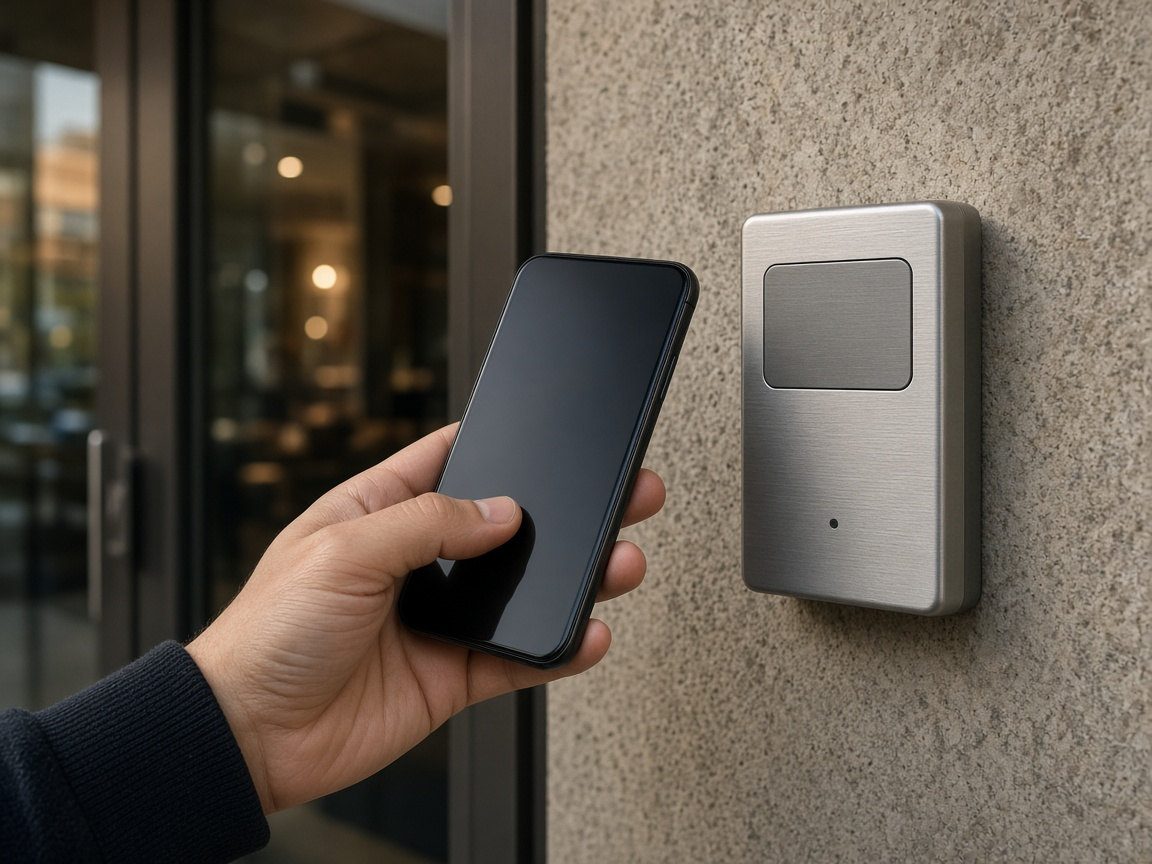
Ask residents what they'd change about their building and "stop making me carry a fob" will be on the list. In 2026, a phone credential is no longer exotic. The questions for boards and property managers are which kind, on which readers, and what happens to everyone who doesn't want one.
Three ways a phone opens a door
Bluetooth through an app. The resident installs the building's or vendor's app, which holds the credential. Tap a button, or simply approach the reader, and the phone sends the credential over Bluetooth Low Energy. It works on almost any phone but depends on that app being installed, signed in and allowed to run in the background.
NFC tap. The phone acts like a contactless card: hold it near the reader and it presents the credential, just as it would for a payment. It's quick and familiar, but the reader needs NFC hardware that supports the credential type.
Wallet passes. The credential sits in the phone's built-in wallet (Apple, Google or Samsung) instead of a separate app. Residents get the tap-to-pay experience they already know, and there's no extra app to install or keep signed in.
Ultra-wideband (UWB) is the next layer. It locates the phone precisely enough for a door to unlock as you walk up with the phone in your pocket, and to check that you're actually standing in front of that door. Not every phone has UWB, so treat it as an extra.
What changed in 2026: Aliro
Until this year, every mobile credential was tied to a vendor. The reader, the app and often the wallet integration came from one company's stack, and switching meant starting over.
In February, the Connectivity Standards Alliance, the industry body behind the Matter smart-home standard, released the Aliro 1.0 specification. It's a common protocol for how phones and wearables talk to access readers, and it names single- and multi-family residential buildings among its targets. It supports NFC for tap-to-open, Bluetooth LE for longer-range unlocking, and Bluetooth LE plus UWB for hands-free entry. Apple, Google and Samsung have committed their wallets to it, and the Alliance says the standard also works where there's no network coverage, such as underground parking garages and elevators.
The fine print matters for anyone buying hardware right now. The chair of Aliro's steering committee told SecurityInfoWatch that Aliro covers the link between the phone and the reader, not the access control system behind it. He also said the commercial rollout "will take time, products, and practical migration," with consumer products likely to lead and commercial deployments to follow as certified products come to market.
So Aliro is a reason to ask your vendor about its readers' upgrade path. It isn't yet a reason to expect any phone to work with any building.
Why the pressure to move off fobs is real
Security. Many older buildings still use 125 kHz proximity fobs. As one security researcher's widely cited breakdown of attacks on proximity card systems explains, these cards simply transmit a pre-programmed code to the reader, which is why they're easy to copy. Modern mobile credentials use encryption and mutual authentication. Aliro 1.0, according to the Alliance, is built on asymmetric cryptography.
Administration. A phone credential can be issued before move-in day and revoked the moment someone moves out, with no fob to collect and no stock of blanks in the management office.
Market direction. In HID's 2026 State of Security and Identity Report, based on more than 1,500 security and IT professionals, end users and partners, security improvements (50%) overtook convenience (34%) as the main reason organizations adopt mobile credentials. According to an ASSA ABLOY executive's summary of the same report, 36% of organizations have already deployed mobile credentials and another 38% plan to. Those figures cover all sectors, not just residential, and HID is a credential vendor, so read them as a direction of travel rather than a condo benchmark.
Why you'll still be issuing fobs
The same HID report found that 84% of end users keep physical credentials alongside their mobile deployment. In a condo, the reasons are obvious:
- Residents without a smartphone, or who don't want building access on it.
- Children, care workers, dog walkers and cleaners.
- Contractors and movers who need access for a day.
- Dead batteries, lost phones and new phones mid-transfer.
The goal is not "mobile only." It's one credential record per person that can show up as a fob, a phone, or both, without the management office keeping two lists.
The architecture question behind the app
Most of the frustration with mobile access comes not from the phone but from what sits behind it.
In a patchwork building, the mobile credential often lives in a vendor cloud, the fob database lives on an old server in the electrical room, and the entry phone has a third resident list. When someone moves out, three systems need updating. When the internet drops, the cloud-issued credentials may stop syncing, depending on how the readers cache permissions.
In an integrated setup, each resident has one record in one database, and the phone credential, fob, entry-phone listing and parking permission all hang off it. With an on-site server, or a hybrid design where an on-site controller keeps working and syncs to the cloud, doors keep making decisions locally during an internet outage. Remote issuing from a phone or a management portal still works whenever the connection is up.
Cloud-only systems have real strengths: no server to maintain, easy multi-site management, fast feature updates. If you choose one, ask how each door behaves when the building loses its connection for a day, not just for a few minutes.
What this means for your building
- Treat phone access as a reader decision first. The readers you install this year will set your options for a decade. Ask whether they support NFC and Bluetooth now and have a firmware path to Aliro.
- Plan for hybrid credentials. Budget for fobs alongside phones for years to come.
- Retire 125 kHz proximity fobs as part of any upgrade, even if you don't go mobile right away.
- Insist on one resident record across doors, elevators, entry phone and parking, whichever credential people carry.
- Write the outage rule down: what still opens, and what doesn't, when the internet is down?
Questions to ask your vendor
- Do your readers support NFC, Bluetooth and UWB today? Which models are on your Aliro certification roadmap, and is the upgrade a firmware update or a hardware swap?
- Can residents use wallet passes (Apple, Google, Samsung), or only your app?
- Is the mobile credential stored in the same database as fobs, the entry phone and parking, or synced from somewhere else?
- If our internet goes down for 24 hours, can every resident still get in, and are those events logged?
- How quickly does a revoked phone credential stop working at every door?
- What does it cost per resident per year, and what happens to our credentials if we change vendors?
Phone-as-key is ready for residential buildings, as long as the phone is one more way to carry a credential your building already manages well, and not another system to keep in sync.