Access
Fob vs phone-as-key vs facial recognition: how a board should choose
A fob, a phone and a face are not interchangeable credentials. Most residential buildings should pick a primary and a fallback — and treat facial recognition as a privacy decision, not a default.
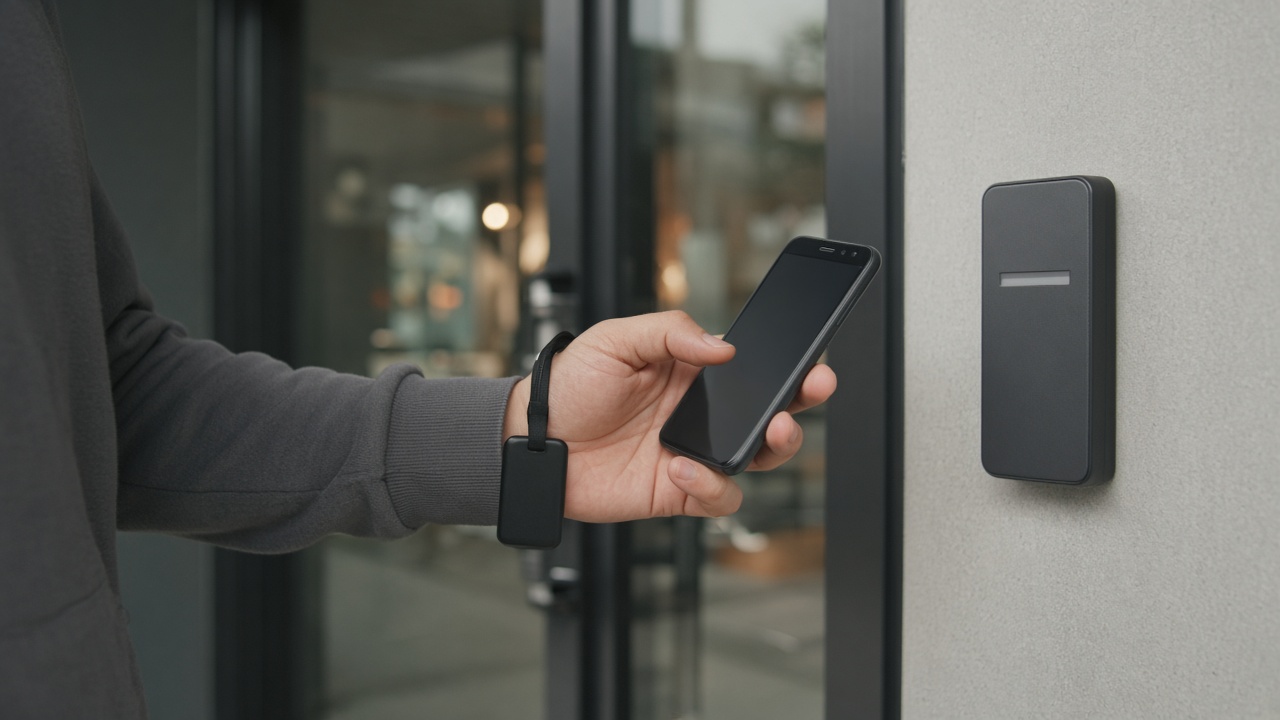
The credential is the part of an access system that residents actually touch. It is also the part boards tend to decide last, after the hardware is already chosen. That is backwards. The credential determines how people get in when their phone is dead, how quickly you can cut off a lost token, and how much personal information the building has to hold.
This is a decision guide, not a product review. For the current state of mobile credentials themselves, see our earlier piece on phone-as-key in 2026. What follows is how to choose among the three options most vendors now put on the table: a physical fob or card, a phone, and a face.
What a fob still does well
A physical credential is simple. It does not need a battery, a cellular plan or a software update. A superintendent can issue a spare at the desk. Residents who do not want a building app — or who share access with a caregiver, a cleaner or a teenager who does not have the right phone — can still get in.
The weaknesses are familiar. Fobs are lost and borrowed. Older low-frequency proximity tokens can be copied with inexpensive tools. Issuing and retrieving them is work, and that work is often done badly, which is how former residents keep entering the garage six months after they move out. A modern smart card is harder to clone than a classic proximity fob, but only if the system is actually using the stronger technology, not just a reader that could.
If you stay with cards or fobs, specify a current, encrypted credential, a written process for cancelling lost ones the same day, and a regular audit of who still has a live token.
What the phone is for
A phone-as-key credential, stored in a vendor app or in a mobile wallet, is convenient for people who already unlock everything else with their handset. It can be issued remotely, revoked remotely, and, in some designs, limited to a window of time or a set of doors. That is a genuine advantage for visitor and trade access.
It is a poor only method. Phones run out of battery, get replaced, or stay in a coat in the car. Wallet ecosystems and reader support still vary by handset, region and vendor, which is why any honest mobile deployment still issues a backup card. Open efforts such as the Connectivity Standards Alliance's Aliro are meant to reduce that lock-in over time. They are not a reason to assume every resident's phone will work on day one.
Budget for the backup credential, for the staff time to help residents enrol, and for the resident who will never install the app.
Why a face is a different decision
Facial recognition at the door is sold as the credential you cannot forget. In a condo, it is also a biometric of everyone who lives in or visits the building, collected in a place they cannot reasonably avoid if they want to get home.
Canada's privacy commissioners have published guidance for businesses that process biometrics. The bar is high: a clear purpose, an assessment of whether a less intrusive option would do, meaningful consent, and careful limits on retention, access and disclosure. In a residential building, "meaningful consent" is difficult if the alternative is to stand outside. Lighting, hats, ageing, children and accessibility all affect how well a face system works in a real lobby. And unlike a fob, a face is not something a resident can leave in a drawer.
If a vendor proposes facial recognition, treat it as an optional, clearly signed convenience at selected doors — not as the only way in — and get written legal advice before you turn it on. Ask where the templates are stored, who can export them, how a resident opts out, and what happens to the data when the contract ends.
A practical way to choose
Most buildings should not pick a single method. They should pick a primary credential and a fallback, then write the enrolment rules.
- A card or fob remains the most inclusive default, especially in buildings with a wide age range or frequent trade access.
- A phone credential is a strong complement once you have confirmed reader and wallet support for the handsets your residents actually carry, and once a backup card is part of the price.
- Facial recognition is the most privacy-sensitive option and the least forgiving to get wrong. It should not be the foundation of a residential system.
Whatever you choose, the credential has to live in the same record as the doors, the intercom and the elevator. A high-tech token on a disconnected system is still a disconnected system.